
Autonomous Vehicles and Private Property Traffic Control
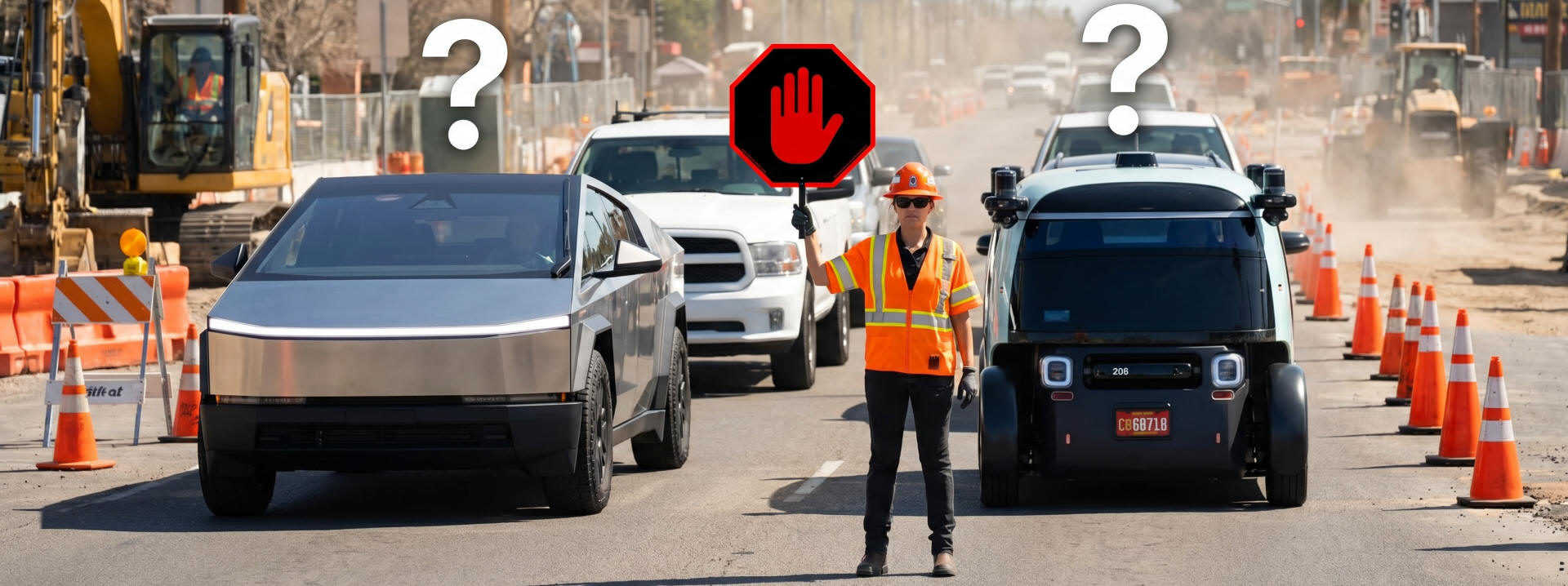
Autonomous and driver-assisted vehicles can detect a flagger, but interpretation of hand-held traffic control signals is not always consistent.
As advanced driver-assist systems and autonomous vehicles become more common, questions are emerging around how these technologies interact with traditional traffic control methods. This includes hand-held STOP / SLOW paddles, symbol-based traffic signs, and human-directed traffic control in private property environments.
This report provides a practical overview of how vehicles such as Tesla and autonomous systems like Zoox currently respond to human traffic control in real-world conditions.
Human Presence vs. Signal Recognition
Modern vehicles equipped with advanced driver assistance or autonomous systems rely heavily on cameras, sensors, and artificial intelligence to interpret their surroundings. These systems are highly effective at detecting:
- Pedestrians and human movement
- Lane markings and roadway geometry
- Traffic lights and standardized road signs
However, interpretation of non-standard or custom signals, including hand-held paddles or symbol-based traffic control devices, is far less consistent.
Key distinction:
- Detection: The vehicle sees a person or object
- Understanding: The vehicle correctly interprets intent or instruction
In most cases, vehicles prioritize detection and safety over interpreting directional commands from non-standard signals.
Tesla Driver Responsibility and System Limitations
From Tesla’s own documentation:
- Driver must remain fully responsible at all times
- System has limitations detecting objects and interpreting situations
Translation:
If a Tesla approaches a flagger or traffic control situation, the human driver is still expected to recognize and respond to the signal. The system itself may assist, but it is not relied upon to fully interpret the situation.
Key implication:
Tesla does not need to fully “understand” a traffic control paddle because the driver remains legally and operationally in control of the vehicle.
Fully Autonomous Vehicles and Human Interaction
Vehicles designed for full autonomy, such as robotaxis, use a combination of sensors, mapping systems, and predictive modeling to navigate environments. These systems are designed to identify people as high-priority elements within their surroundings.
In traffic control scenarios, autonomous vehicles typically:
- Detect the presence of a person in or near the roadway
- Classify that person as a potential risk or controlling agent
- Slow, stop, or proceed cautiously based on movement and positioning
However, there is currently no universal standard requiring these systems to interpret hand-held paddles or custom symbol-based signals in the same way a human driver would.
Work Zones, School Zones, and Flagging Operations
Traditional traffic control in work zones and school zones relies on human flaggers using STOP / SLOW paddles and hand signals. These systems are designed for human interpretation and vary in execution depending on the individual and the environment.
Autonomous vehicle systems face challenges in these environments due to:
- Variability in human gestures
- Differences in paddle design and visibility
- Lack of standardized datasets for training
As a result, vehicles often default to conservative behavior, including slowing, stopping, or hesitating when encountering human-directed traffic control.
Symbol-Based Traffic Control and Autonomous Systems
Symbol-based traffic control, including the use of visual indicators such as halt hands or directional arrows, is widely understood by human drivers. However, for autonomous systems, interpretation depends on whether the symbol has been included in training data and recognized as a standardized input.
While some symbols may be visually detected, consistent interpretation is not guaranteed unless they are part of a widely recognized and standardized traffic control system.
This is especially relevant for private property environments, where custom or non-standard traffic control solutions are more common.
While symbol-based traffic control is intuitive for human drivers, interpretation by autonomous systems is still evolving. Halt-Pro Traffic Control Paddles are designed specifically for human-directed traffic environments where clear visual communication is essential.
Private Property Traffic Control: The Current Reality
In private property environments such as parking lots, event venues, resorts, and controlled access areas, traffic control is often managed by personnel rather than fixed infrastructure.
In these settings:
- Human presence remains the primary control mechanism
- Visual signals support communication but are not always machine-readable
- Autonomous vehicles prioritize safety over instruction compliance
For private property environments where human-directed traffic control is common, solutions such as hand-held paddles are still widely used. View the Halt-Pro Traffic Control Paddle to see a modern, symbol-based alternative designed for parking areas, events, and controlled traffic environments.
This means that even as autonomous technology advances, human-directed traffic control will continue to play a critical role in managing vehicle flow in these environments.
Conclusion
Autonomous and driver-assist vehicle systems are advancing rapidly, but interaction with human traffic control remains an evolving area.
At present:
- Vehicles reliably detect people but do not always interpret their signals
- Standardized roadway controls are more consistently recognized than custom solutions
- Human drivers remain responsible in partially autonomous systems
- Fully autonomous systems prioritize caution and safety over directional compliance
For private property traffic control, this reinforces the importance of clear human presence, strong visibility, and practical real-world signaling methods.
Organizations looking for a more modern hand-held solution for private property use can explore Halt-Pro Traffic Control Paddles here.