
How Embracing Innovation Keeps Companies Ahead
In the fast-moving world of business, standing still is one of the quickest paths to irrelevance. History is filled with companies that once dominated their industries until technology changed, customer expectations shifted and more adaptable competitors moved ahead.
Companies such as Kodak, Blockbuster, Nokia, BlackBerry, Sears and Polaroid all provide versions of the same lesson: past success does not guarantee future survival.
Today, artificial intelligence is one of the most important technological shifts facing businesses, creators and individuals. Those who are not afraid of it, learn how to use it responsibly and apply it for productive purposes are likely to adapt and flourish. Those who refuse to understand it risk falling behind.
My Evolving View of Artificial Intelligence
I originally created this page to clarify my stance on artificial intelligence. Since then, I have gained a much stronger understanding of what AI can and cannot do.
I do not believe AI should replace human judgment, experience, creativity or common sense. I believe it is a tool that can help people think more clearly, explore ideas more deeply and accomplish work that may have previously required more time, money or outside assistance.
Artificial intelligence has considerably improved my business presence. It has helped me organize ideas, strengthen website content, improve product positioning, analyze opportunities and present my businesses more professionally.
It has also boosted my creativity and thought process. AI does not simply give me answers. Used properly, it challenges me to consider new angles, refine unfinished ideas and turn thoughts that have been sitting in my head into something practical.
My Position on AI
AI is neither automatically good nor automatically bad. Its value depends on how it is used. Those who approach it with curiosity, responsibility and common sense can use it to improve their businesses, develop new ideas and expand their creative abilities.
Cautionary Tales of Missed Opportunities
Kodak developed an early digital camera in 1975 but remained heavily committed to film. The company helped create the technology that would transform photography but failed to lead the transition.
Blockbuster became one of the most recognized names in home entertainment but underestimated how quickly customers would move toward subscription services and streaming. Netflix adapted its business model while Blockbuster remained tied to physical stores.
Nokia and BlackBerry dominated important parts of the early mobile-phone market but struggled to respond when smartphones, touchscreens and modern app ecosystems changed what customers expected from a phone.
Sears was once a pioneer of catalog-based shopping and home delivery, but it failed to translate that strength into leadership during the rise of e-commerce.
Polaroid built its identity around instant film photography but could not adapt quickly enough as digital photography became mainstream.
Common thread? They relied too heavily on what had worked in the past instead of preparing for what customers would want next.
Modern Examples of Adaptation
Netflix evolved from mailing DVDs to streaming entertainment and later producing original programming. Its success came from understanding that its real business was not mailing discs. It was delivering convenient entertainment.
Amazon expanded far beyond online book sales by continually investing in logistics, cloud computing, automation, data analysis and new ways of serving customers.
Spotify uses technology and machine learning to personalize music discovery, recommend artists and keep listeners engaged.
Adobe transitioned from boxed software to subscription-based cloud services and has continued adding AI-assisted tools for design, photography, video and content creation.
The companies that remain competitive are rarely the ones that protect every old process. They are the ones willing to examine what is changing and decide how to respond before they are forced to.
AI in the Music Industry: Threat or Tool?
The music industry has evolved from vinyl records to tapes, compact discs, downloads and streaming. Artificial intelligence is another major step in that evolution.
AI music tools can assist with composition, arrangement, production, mixing, mastering and experimentation. Some musicians view this as a threat. Others see it as another instrument.
I have personally taken song creation to another level with Suno.
Suno has allowed me to take ideas, concepts, moods and lyrics and hear them developed into complete songs. It does not replace my involvement. I still choose the subject, direction, wording, style and emotional intent. The technology helps transform those ideas into something I can hear, evaluate and improve.
That process has expanded the way I think about music. A person no longer needs access to a recording studio, session musicians and a large production budget just to explore whether a song idea has potential.
The future of music is not simply man or machine. It is what a creative person can accomplish with the right tools.
How AI Helps Small Businesses Compete
Artificial intelligence is not only for large technology companies. It can be especially valuable to small businesses that do not have large marketing departments, writing teams, analysts or design staffs.
- Website development: Organize information, improve page structure and create clearer customer-focused content.
- Search visibility: Identify missing topics, answer customer questions and improve how products and services are presented.
- Product development: Explore concepts, compare alternatives and refine ideas before investing in prototypes.
- Marketing: Develop campaigns, headlines, product descriptions and industry-specific messaging.
- Customer communication: Improve emails, proposals, instructions and responses.
- Research: Organize information and examine a subject from multiple perspectives.
- Decision-making: Compare risks, opportunities and possible outcomes before taking action.
- Creativity: Turn rough ideas into stronger concepts, visuals, stories, songs and business opportunities.
How AI Has Helped Boulevard Supply
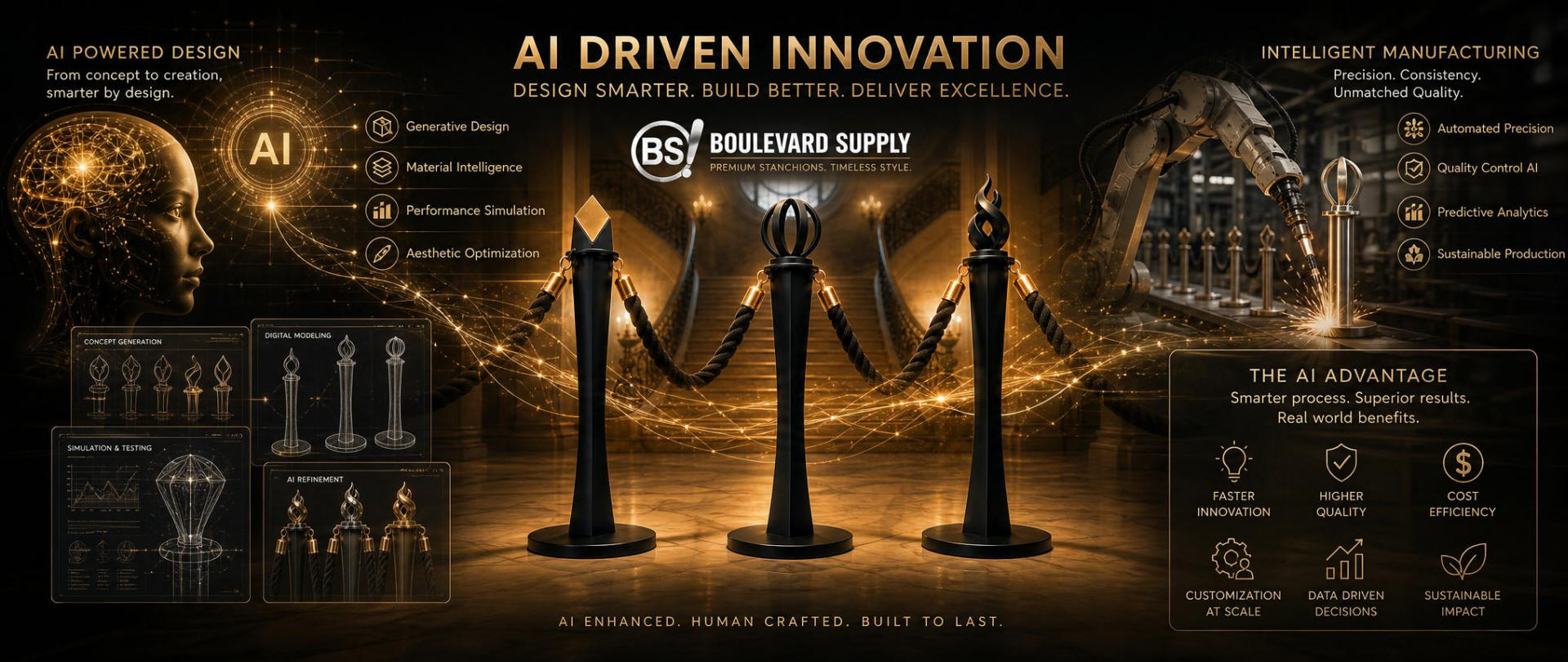
Artificial intelligence has become a valuable part of how I develop and improve Boulevard Supply, Stanchion Masters®, Luxe Stanchions® and the other websites and product concepts I manage.
It has helped me examine pages that had become outdated, rethink how products are positioned, create better explanations for customers and identify industries or applications I may not have considered.
It has also helped me connect ideas across different parts of the business. A product feature may lead to a new marketing angle. A customer question may lead to a new page. A photograph may lead to a comparison, a product improvement or an entirely new concept.
AI has not replaced my business knowledge. It has helped me use that knowledge more effectively.
Human Experience Still Matters
An AI system does not know my customers, products or industries the way I do. It does not have decades of personal experience, and it does not automatically understand which ideas are practical. The best results come from combining technology with human judgment, real-world knowledge and the willingness to question the output.
The Return on Innovation
Companies that adapt do not merely survive disruption. They often become stronger because they learn to operate more efficiently and recognize opportunities sooner.
- Efficiency: Reduce time spent on repetitive or administrative work.
- Insight: Examine information from more than one angle.
- Speed: Move ideas from concept to execution more quickly.
- Creativity: Explore possibilities that may not have been practical before.
- Relevance: Respond to changing customer expectations and technology.
- Independence: Accomplish more without relying on a large staff or expensive outside services.
Use AI, But Do Not Surrender Your Judgment
Embracing artificial intelligence does not mean blindly trusting everything it produces.
AI can misunderstand context, repeat incorrect information, make weak assumptions or produce confident answers that still need to be verified. It should be used as a partner in the thought process, not as a replacement for responsibility.
Businesses should continue protecting customer information, respecting intellectual property, checking important facts and making final decisions based on human judgment.
The people who benefit most from AI will not necessarily be those who use it the most. They will be those who learn when to use it, how to question it and when not to rely on it.
Final Thoughts: The Choice Is Clear
Kodak did not fail simply because digital cameras emerged. Blockbuster did not disappear only because streaming became available. Their deeper problem was failing to adapt quickly enough when the world around them changed.
Artificial intelligence is one of today’s major disruptors.
You can ignore it and hope it goes away, or you can learn how it works, decide where it provides value and use it responsibly.
For me, AI has already improved my business presence, strengthened my creativity, expanded my thought process and opened new possibilities in both business and music.
I do not fear artificial intelligence. I respect its power, recognize its weaknesses and intend to continue learning how to use it for productive and creative purposes.
Adapt or fade. The future is already here, and I intend to keep moving with it.